Amiculum Blog Article
Simultaneous publications: profiling this prevalent practice and planning for success
Simultaneous publications: profiling this prevalent practice and planning for success
Simultaneous publications: profiling this prevalent practice and planning for success
Simultaneous publications: profiling this prevalent practice and planning for success
Introduction: greater expectations
Simultaneous publications, whereby a peer‑reviewed manuscript is published to coincide with a congress presentation of the same data, have become increasingly common.1,2 Many stakeholders now regularly expect them to be delivered for practice-changing clinical trial results. However, notable challenges can include development timelines and stakeholder alignment. Inadequate planning may exacerbate these challenges and lead to issues with publication quality, ethics, copyright and accessibility. Using the latest evidence and insights, we highlight the benefits of this growing practice and how to overcome emerging challenges.
Uncovering an established trend
The prevalence of simultaneous publications is clearly on an upward trajectory:
- As reported in our poster presentation at the 2026 Annual Meeting of ISMPP,1 69% of all original research articles (ORAs) published by The New England Journal of Medicine (NEJM) during a 6-month period were simultaneous. For articles that acknowledged industry support, this proportion increased to 85%; just 15% of industry-sponsored ORAs were published asynchronously
- NEJM now regularly publishes >10 ORAs to coincide with major medical congresses (eg ASCO 2025, ESC 2025, ACC 2026), but this approach isn’t restricted to the largest congresses: NEJM publications coincided with >35 different congresses during the past year
- This practice extends to therapy-area-specific journals, especially those affiliated with congresses, with many journals now encouraging submissions3–5
- Proactivity by publishers can result in >100 simultaneous publications at a single congress (eg ESC 2025)
- The practice is now sufficiently widespread that it is common to see secondary analyses being published simultaneously, as well as examples of simultaneous publication to coincide with poster presentations
What is driving the practice?
The practice is driven largely by the potential benefits conferred by:
- Greater impact, reach and engagement
- Immediate access to more detailed findings and interpretation6
- Acceleration of activities reliant on citable publications
While chairing a roundtable discussion on the benefits and challenges of simultaneous publications at the 2025 European Meeting of ISMPP, it became clear that attendees were not fully convinced by the supposed benefits owing to a lack of supporting evidence. Instead, the prestige for the stakeholders involved was considered a principal driving factor. However, emerging evidence increasingly suggests that simultaneous publications can drive media engagement.1,7 Currently, insufficient evidence exists to show whether expedited publication can lead to faster inclusion of investigational treatments into guidelines,7 but quicker access to a citable, peer-reviewed manuscript can certainly be beneficial for scientific exchange. In addition, the availably of manuscript peer-review comments shortly before initial presentation of the data at a medical congress can increase the quality of the presentation content and resulting discussion.
What are the challenges?
Key challenges include:
- Thorough planning
- Stakeholder alignment
- Expedited development timelines
Attendees at the 2025 European Meeting of ISMPP roundtable commented that, in their experience, the development of simultaneous publications is always expedited. In some cases, lead times from data availability to manuscript submission were as little as 1 week. This highly expedited nature can exert pressure on resources, stakeholder availability, adherence to ethical publication practices and data accuracy, potentially leading to errata. Many roundtable participants also commented on significant difficulties associated with managing stakeholder expectations.
Inadequate planning and communication may exacerbate these challenges and lead to unexpected issues with copyright and accessibility, especially for articles published under a Creative Commons non-commercial (NC) and/or no derivatives (ND) licence. This can impact secondary publication plans and medical affairs activities. At least one publisher has been known to deny the subsequent development of ‘plain-language summary of publication’ (PLSP) articles, which can further inhibit the reach of important clinical information to key audiences.
A passing trend or established practice?
Based on the current prevalence of simultaneous publications, we recommend that publication teams should already be discussing the feasibility of a simultaneous publication if they plan to target a high-impact journal, notably, NEJM.1
However, simultaneous publications may become increasingly prevalent owing to:
- Increasing social media engagement1,7,8
- AI-driven efficiencies in publication development
As discussed in our recent video podcast, we’re progressively incorporating AI-assisted processes into our day-to-day publication workflows. As more effective tools become available and stakeholders become more familiar with AI-assisted workflows, we can expect to see shorter development timelines and more projects being developed concurrently.
Finally, greater adoption by journals may increasingly impact our approach to regular (asynchronous) manuscripts too. With some journals already publishing a high proportion of their articles simultaneously (including >10 articles to coincide with major congresses),1 if we avoid submitting regular manuscripts in the 2-month period before major congresses, our articles may be processed faster and have a greater impact upon publication.
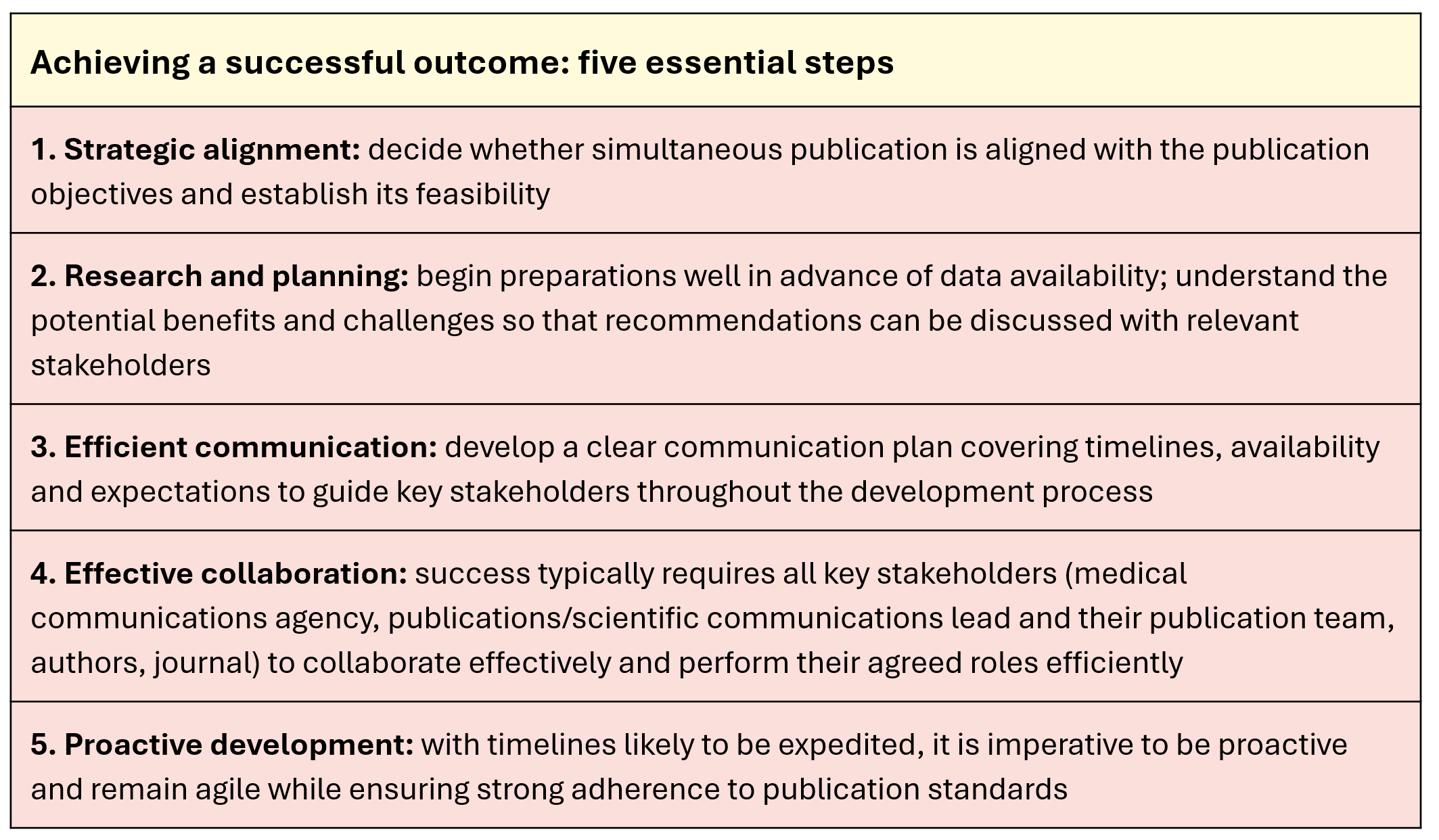
Guiding you through the process: our Amiculum resource
Contact us to obtain our comprehensive simultaneous publication resource, which provides step-by-step guidance to ensure that you plan appropriately. Our practical recommendations will also help you to avoid commonly encountered challenges and increase the likelihood of achieving a successful outcome.
Our recommendations are based on our collated experience from a wide variety of journals and therapy areas over the past 10 years. The two most recent simultaneous publications supported by Amiculum (both coinciding with presentations at WCN, 28–31 March 2026) were published in significantly different journals (NEJM and Journal of the American Society of Nephrology),9,10 yet both required detailed planning and efficient collaboration between stakeholders to achieve the strategically desired outcome.
Complete the form below for a copy of our simultaneous publications resource
Contact CTA
Get in touch
If you would like to discuss best practices for planning and delivering a simultaneous publication, please get in touch
Simultaneous publications: profiling this prevalent practice and planning for success
About the author

Congress abbreviations: ACC, American College of Cardiology; ASCO, American Society of Clinical Oncology; ESC, European Society of Cardiology; ISMPP, International Society for Medical Publication Professionals; WCN, World Congress of Nephrology
References:
- Clarke B et al. The era of simultaneous publication (SP): profiling this practice at a prominent medical journal and congresses. Poster 34 presented at the 22nd Annual Meeting of the International Society for Medical Publication Professionals (ISMPP); Washington, DC, USA; 20–22 April 2026. Poster available here: https://bit.ly/4rgQ59B
- Schuler KW et al. Parallel publication of articles and congress presentations for industry-sponsored research: strategies for success. Curr Med Res Opin 2022;38:875–80
- The Journal of the American College of Cardiology (JACC) Journals. Submit your EuroPCR research for publication in JACC journals. https://www.jacc.org/call-for-papers (accessed 1 April 2026)
- American Association for Cancer Research (AACR) journals. The power of simultaneous publication. https://vimeo.com/showcase/11942115?video=1157643942 (accessed 1 April 2026)
- American Society of Clinical Oncology (ASCO) Publications. Submit manuscript. https://ascopubs.org/authors/submit-manuscript (accessed 1 April 2026)
- Spagnolo M et al. Association of trial characteristics with simultaneous publication and its impact on citations and mentions: a cross-sectional study. Rev Esp Cardiol (Engl Ed) 2024;77:324–31
- Patel S et al. Rapid reporting: the influence of simultaneous publication on the speed of oncology clinical trial data dissemination. Curr Med Res Opin 2025;41(Suppl 1):4–21
- Roberts-Lewis S et al. Examining the effectiveness of social media for the dissemination of research evidence for health and social care practitioners: systematic review and meta-analysis. J Med Internet Res 2024;26:e51418
- Barratt J et al. Iptacopan in IgA nephropathy – final 24-month data. N Engl J Med 2026; doi: 10.1056/NEJMoa2600743
- Heerspink HJL et al. Efficacy and safety of atrasentan in patients with IgA nephropathy receiving sodium-glucose cotransporter 2 inhibitors: placebo-controlled, crossover trial. J Am Soc Nephrol 2026; doi: 10.1681/ASN.0000001076
Simultaneous publications: profiling this prevalent practice and planning for success
Simultaneous publications: profiling this prevalent practice and planning for success
Loading posts...
No posts found.