Amiculum Blog Article
Who shapes medical decisions now? KOLs, DOLs, VOLs and the future of Medical Affairs engagement
Who shapes medical decisions now? KOLs, DOLs, VOLs and the future of Medical Affairs engagement
Who shapes medical decisions now? KOLs, DOLs, VOLs and the future of Medical Affairs engagement
How key opinion leaders (KOLs), digital opinion leaders (DOLs) and virtual opinion leaders (VOLs) are reshaping medical affairs engagement: insights from MAPS Denver 2026
Published: April 2026
Event: MAPS Americas 2026
Location: Denver, Colorado
Audience: Medical affairs leaders, digital engagement teams, pharmaceutical organizations
Topics: KOL engagement, DOL strategy, VOLs, AI in medical affairs, governance, omnichannel engagement
Key takeaway: At MAPS Denver 2026, medical affairs leaders concluded that influence is progressing from traditional KOL-led engagement toward a layered model that includes DOLs and, increasingly, VOLs. The strategic opportunity now lies in helping organizations govern how artificial intelligence (AI) systems shape visibility, trust and next best scientific actions.
Influence in healthcare is no longer shaped by traditional KOLs alone. Today, decision making is increasingly influenced by a broader ecosystem that includes DOLs and, increasingly, VOLs alongside traditional scientific experts.
For many Medical Affairs teams, VOLs are still an emerging concept. In simple terms, we define VOLs as algorithmic or AI-driven interfaces that influence what audiences see, trust and do next, from AI search summaries and recommendation engines to governed assistants and next-best-action systems.
At our MAPS Americas workshop, participants brought this shift to life through practical engagement scenarios, designing plans that were realistic, compliant and genuinely audience centred. What emerged was not only a clear articulation of today’s influence landscape but also a stronger perspective on where medical affairs can lead next. Feedback scores reinforced the relevance (scored 4.8 out of 5), engagement (4.6/5) and real-world applicability (4.9/5) of the discussion.
Most importantly, one thing became clear: the conversation is shifting from what VOLs could be to if, where and how they can be meaningfully applied in real audience engagement.
1. Influence is layered, not replaced
Across all engagement scenarios, groups reinforced a core principle from the session: this is not about replacing KOLs but about layering influence strategically.
- KOLs continue to anchor credibility, evidence generation and guideline development
- DOLs extend reach, relevance and peer-to-peer resonance
- VOLs increasingly shape what audiences encounter first through AI summaries, algorithms, recommendation engines, avatars and next-best-action systems
These interfaces are no longer passive channels. They actively shape interpretation, prioritization, discoverability and behaviour. As a result, Medical Affairs teams should begin treating VOLs as a formal layer within the broader influence ecosystem.
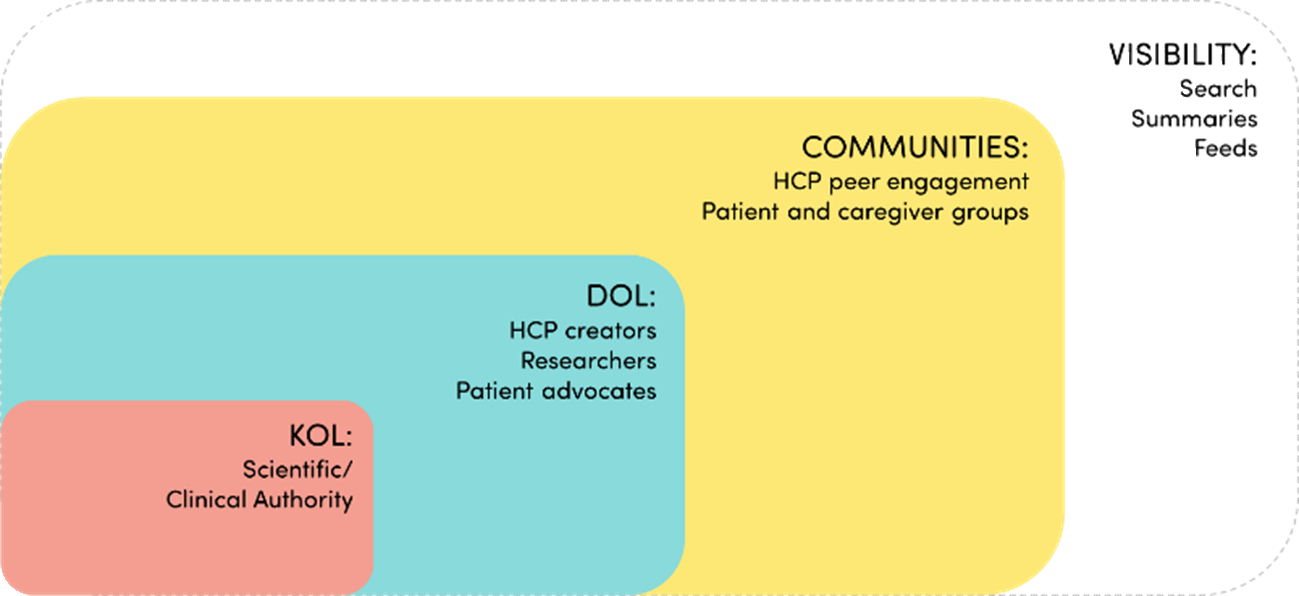
Figure 1. Influence layering framework
2. Clear objectives for thought-leader engagement matter more than tactics
When applying the influence layering framework to audience engagement planning, participants consistently stressed the importance of being precise about what success should look like.
Rather than defaulting to awareness alone, objectives focused on:
- Building understanding and confidence ahead of launch
- Supporting behaviour change and informed decision making
- Enabling peer-to-peer education
- Creating trust and long-term relationships
This same discipline now applies to VOLs. If AI interfaces are influencing the user journey, teams need clarity on which decision, behaviour or perception the VOL layer is intended to shape.
3. Selection and design need structure, not instinct
Many groups at the workshop discussed how difficult it can be to identify the right DOLs in crowded or high-risk environments.
The same structured thinking needed for effective DOL identification should now extend to VOL design, although the principle is slightly different. With VOLs, it’s less about who to engage and more about which systems and decision points are shaping interpretation.
Teams need to ask:
- Which algorithms surface the content?
- Which AI systems summarize the evidence?
- Which interfaces are trusted enough to influence behaviour?
- Which recommendation engines shape the next best action?
This represents the progression from traditional opinion leader mapping to influence architecture, combining human and machine-mediated influence into a single strategic model.
4. Trust, ethics and compliance must be key considerations
These considerations featured prominently in every discussion.
Key themes included:
- Managing misinformation and message distortion
- Transparency and disclosure
- Governance and auditability
- Explainability of AI-driven recommendations
- Internal uncertainty around what is permissible
The strongest consensus was that this only works when risk, compliance and governance are built in from the start. As VOLs become more prominent in scientific exchange, trust is not a downstream metric but a design principle.
5. Internal readiness is what makes DOL and VOL strategy scalable
A recurring insight was that successful engagement is often limited less by external appetite and more by internal infrastructure.
Key enablers included:
- Social listening and monitoring capabilities
- Clear internal processes and approval pathways
- Cross-functional alignment across Medical, Legal, Compliance and Digital teams
- The right skills and confidence within Medical Affairs teams
This is where the real opportunity lies for Medical Affairs teams: operationalizing DOL and VOL strategies through governance, AI-ready content models and practical next-best-action frameworks.
6. Measuring impact requires more than traditional metrics
When discussing metrics, many groups at the MAPS session moved beyond reach and impressions to focus on:
- Quality of engagement and dialogue
- Indicators of trust and confidence
- Specific changes in behaviour over time
- Feedback from communities themselves
There was strong agreement that meaningful impact often appears qualitatively before being visible quantitatively. This becomes even more important when assessing the influence of VOL systems across complex decision journeys.
Final reflections
One of the strongest messages from the workshop was that modern influence is already shaping medical decision making, whether medical affairs is actively involved or not.
The opportunity now is for Medical Affairs teams to take ownership of the VOL space strategically and proactively.
That means helping teams build:
- VOL influence maps
- AI-ready scientific content ecosystems
- Governed AI avatars and assistants
- Next-best-action orchestration
- Measurement frameworks for machine-mediated influence
The organizations that lead here will not simply react to AI-driven influence. They will work with partners, internal stakeholders and their scientific communities to shape it ethically, strategically and with scientific integrity at the core. At Amiculum, we’re excited to work with our clients to make this a reality.
About the author

Who shapes medical decisions now? KOLs, DOLs, VOLs and the future of Medical Affairs engagement
Who shapes medical decisions now? KOLs, DOLs, VOLs and the future of Medical Affairs engagement
Contact CTA
Start a conversation
Find out how our experts can address your healthcare communication challenges.
Who shapes medical decisions now? KOLs, DOLs, VOLs and the future of Medical Affairs engagement
Subscribe to our newsletter for the latest insights
Who shapes medical decisions now? KOLs, DOLs, VOLs and the future of Medical Affairs engagement
Loading posts...
No posts found.